

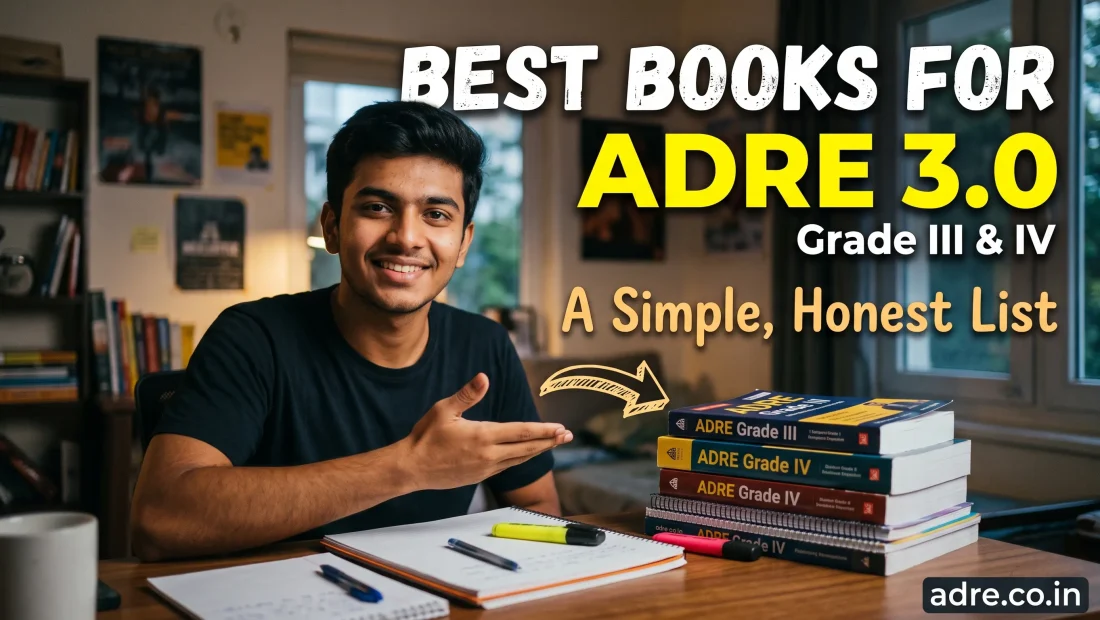
Walk into any bookshop near a coaching centre and you will see shelves full of “ADRE special” guides. It is easy to buy five books on day one and finish none of them.
Table of Contents15 sections
- How to Choose Books for ADRE 3.0
- Quick Comparison Table
- 1. Lucent’s General Knowledge
- 2. NCERT Books (Class 6 to 10)
- 3. An Assam GK Guide (such as “Know Your State: Assam”)
- 4. A History of Assam by Edward Gait
- 5. SCERT Assam Textbooks
- 6. Wren & Martin: High School English Grammar and Composition
- 7. R.S. Aggarwal: Quantitative Aptitude
- 8. R.S. Aggarwal: Verbal and Non-Verbal Reasoning
- 9. Monthly Current Affairs Magazine and a Daily Newspaper
- A Simple Plan to Use These Books
- Common Mistakes to Avoid
- Frequently Asked Questions
- Conclusion
So here is a shorter list. These are books and resources that aspirants commonly rely on for Assam government exams, with a plain review of what each one does well and where it falls short. Always match your choice with the official ADRE 3.0 syllabus before you buy anything. You can read the latest one on our [ADRE 3.0 syllabus page].
How to Choose Books for ADRE 3.0
A few rules save both money and time:
- Pick one book per subject, then revise it again and again. Three half-read books are worse than one book you know well.
- Check the edition. For General Knowledge and Assam-related topics, an old edition can give you outdated facts.
- Start from your Grade. Grade IV candidates can keep the basics strong, while Grade III candidates may need more practice in maths, reasoning and English.
- Free resources count. NCERT and SCERT Assam textbooks cost very little and are often enough for the basics.
Quick Comparison Table
| Subject | Book / Resource | Best for | Level |
|---|---|---|---|
| General Knowledge | Lucent’s General Knowledge | Quick topic-wise revision | Beginner to medium |
| Basics (History, Geography, Science) | NCERT books (Class 6-10) | Building concepts from scratch | Beginner |
| Assam GK | Assam GK guide (for example, Know Your State: Assam) | Assam facts and figures | Beginner to medium |
| Assam History | A History of Assam by Edward Gait | Deeper reading | Advanced |
| Local content | SCERT Assam textbooks | Assam-focused basics | Beginner |
| English | Wren & Martin English Grammar | Grammar rules | Beginner to medium |
| Maths | R.S. Aggarwal Quantitative Aptitude | Practice questions | Medium |
| Reasoning | R.S. Aggarwal Verbal & Non-Verbal Reasoning | Practice questions | Medium |
| Current Affairs | Monthly magazine + Assamese/English newspaper | Last 6-12 months of news | All |
1. Lucent’s General Knowledge
Best for: General Knowledge revision
This is one of the most widely used GK books in India, and the reason is simple: it packs a lot of facts into short, topic-wise sections. It is easy to revise a day before a mock test. The downside is that some data ages quickly, so do not trust it blindly for recent events. Use it for the static portion and add current affairs on top.
2. NCERT Books (Class 6 to 10)
Best for: History, geography, science and civics basics
NCERT books are written in plain language, and they are free to read online. If you feel weak in basics, start here before touching any thick guidebook. They are not exam-focused, so you will not find a long list of MCQs. Read them first, then practise questions from another source.
3. An Assam GK Guide (such as “Know Your State: Assam”)
Best for: Assam-specific facts
ADRE is an Assam exam, so Assam GK deserves its own book. Look for a recent edition that covers districts, rivers, culture, festivals, economy, important schemes and personalities. Quality varies a lot between publishers, so flip through a few pages before buying. If the book has no recent data, you will have to fill the gap with news.
4. A History of Assam by Edward Gait
Best for: Assam history in depth
This is a classic, and many serious learners treat it as a reference. It is detailed, but it is also heavy and written in an older style. Do not try to read it cover to cover. Use it for the topics you find in the syllabus, such as the Ahom period, and pair it with simple notes. Beginners may find it slow going.
5. SCERT Assam Textbooks
Best for: Assam-focused school-level basics
These textbooks are easy to get, easy to read, and they match the local context. They work well as a base for social science and language topics. They will not cover everything an exam may ask, so treat them as the foundation and not the full course.
6. Wren & Martin: High School English Grammar and Composition
Best for: English grammar
A long-running favourite for a reason. The rules are explained clearly, and every chapter comes with exercises. It can feel old-fashioned, and you do not need every chapter for a competitive exam. Focus on tenses, articles, prepositions, voice, narration and error spotting.
7. R.S. Aggarwal: Quantitative Aptitude
Best for: Maths practice
If your problem is speed, this book gives you plenty of questions to work on. The solved examples help you pick up shortcuts. The catch is that it is big, and some of the later exercises go beyond what you may need. Start with the chapters in your syllabus, such as percentage, ratio, average and simple interest, and skip what you do not need.
8. R.S. Aggarwal: Verbal and Non-Verbal Reasoning
Best for: Reasoning practice
You get a huge variety of question types with answers at the back. That is great for practice, but it does not teach you tricks in a smart way. If you get stuck, watch a short video on that topic and then come back to the book.
9. Monthly Current Affairs Magazine and a Daily Newspaper
Best for: Current affairs and Assam news
No book can keep up with the news. Pick one monthly magazine and read a daily Assamese or English newspaper, even for 20 minutes. Make a small notebook for Assam government schemes, appointments, awards and sports. Revise it every Sunday.
A Simple Plan to Use These Books
- Weeks 1-3: Read NCERT and SCERT basics. Make short notes.
- Weeks 4-8: Work through one book per subject. Do 20-30 questions daily in maths and reasoning.
- Weeks 9-10: Revise your notes and solve previous year papers. See our [ADRE previous year question papers] page.
- Last 2 weeks: Take full mock tests, check your weak areas and keep revising current affairs.
Common Mistakes to Avoid
- Buying too many books and reading none of them properly
- Ignoring the official syllabus
- Using old editions for GK
- Reading only and never practising
- Skipping the weak subject because it feels boring
Frequently Asked Questions
Which is the best book for ADRE 3.0?
There is no single best book. Aspirants usually use a mix: a GK book like Lucent, NCERT and SCERT for basics, R.S. Aggarwal for maths and reasoning, and Wren & Martin for English. Choose according to the official syllabus.
Are the same books enough for Grade III and Grade IV?
The core subjects overlap, so most of these books work for both. Grade III aspirants may want more practice in maths, reasoning and English. Check the syllabus for each grade on our [ADRE 3.0 syllabus page].
Can I prepare for ADRE using only free resources?
Yes, to a large extent. NCERT books, SCERT Assam textbooks, previous year papers and a daily newspaper can cover a big part of the preparation. A few practice books help with speed.
Is the Assam GK book necessary?
Yes, in most cases. Since this is a state exam, questions about Assam’s history, geography, culture and schemes are common. A recent Assam GK guide saves time.
How many months do I need to prepare with these books?
It depends on your starting point. Many aspirants plan 3 to 6 months of steady study. A fixed daily schedule matters more than long, irregular sessions.
Where can I find ADRE 3.0 previous year papers and notes?
You can browse our Study Materials section, where we share notes, practice sets and previous year question papers when they are available.
Conclusion
You do not need a stack of books to clear ADRE 3.0. You need the right few, a steady routine and regular revision. Pick your books this week, make a timetable and start. For updates on the notification, apply date and exam date, keep checking our [ADRE 3.0 latest updates] page.
Disclaimer: ADRE.co.in is an independent information website and not an official government portal. Book suggestions are for guidance only. Please verify the syllabus on the official notification.